Three years of intensive collaboration — running from 02.2026 to 01.2029, i-mobyl will develop, test, and establish sustainable mobility solutions for the next generation.
13
Partners
13 strong partners from academia, industry, policy, and civil society combine their expertise — for a project that doesn’t just preach diversity, but lives it. Click here to learn more about us!
5
Countries
A transnational network spanning the Netherlands, France, Austria, the UK, and Switzerland brings together diverse mobility cultures into one approach that’s transferable across Europe.
11-15
Target Group
At the heart of the project are young people aged 11 to 15 — an age group largely unheard in mobility planning so far, yet one meant to actively help shape the city of tomorrow.
Advancing inclusive mobility for young people in urban spaces to promote equity, health & behavior change.
The project i-mobyl – Inclusive Mobility Interventions for Young Adolescents and Livable Urban Spaces addresses the fact that many young people face barriers to sustainable mobility and are rarely included in planning processes. By combining data collection with the co-creation of solutions, i-mobyl develops approaches tailored to their needs within the 15-minute city concept. Interventions are designed and tested in real-world settings through Living Labs, while Evidence Base Cities support data analysis and comparison. The project brings together expertise from urban planning, transport, and public health. Its goal is to support healthier, more inclusive, and sustainable mobility habits in European cities.
Three Pillars. One Shared Vision.
i for Innovation
We explore and develop new approaches to sustainable urban mobility through real-world experimentation. Using Living Labs and data-informed insights, we work with solutions that respond to the needs of young people.
i for Inclusion
We co-create mobility solutions with young people. Through participatory formats, we ensure that different needs, perspectives and lived experiences actively shape future mobility systems.
i for Implementation
We translate validated solutions into practice with cities, schools, and communities. Our focus is on scaling proven concepts into real-world deployment and lasting systemic impact.
The Key Challenges.
Underrepresented Users.
Young adolescents (YA) and their communities are rarely engaged in shaping urban mobility planning. Their mobility practices, preferences, and daily needs are largely absent from current planning processes, despite YA standing to benefit significantly from more inclusive approaches like the 15-minute city concept.
Lack of Co-Creation.
Where visions for future mobility do exist, they are seldom co-created with young adolescents themselves, and are rarely translated into concrete, actionable, and measurable objectives. This leaves a gap between what YA actually want from their urban environments and what gets planned on their behalf.
Limited Empirical Evidence.
There is a lack of robust, multinational empirical data on YA’s full range of daily activity patterns and travel behaviour. Existing research tends to focus narrowly on school commutes, overlooking leisure, shopping, socialising, and other everyday activities that shape how YA actually move through and experience their cities.
Weak Intervention Design.
Few existing mobility interventions are specifically tailored to young adolescents, and those that do exist are often not grounded in established behaviour change theory. This limits their effectiveness in genuinely shifting YA’s travel habits toward more active and multimodal options.
Implementation Barriers.
Local authorities and other key stakeholders are frequently left out of the co-creation and testing process, while high resource demands and limited local buy-in further constrain the ability to implement and scale interventions in real-world settings.
The Objectives.
Improve understanding of mobility behavior, needs and daily travel patterns.
Co-create mobility solutions with youth and key stakeholders.
Test and evaluate interventions in real-world settings through living labs.
Want to Learn Further Objectives?
Details on further objectives:
To strengthen the representation of YA in urban mobility planning — how YA move in cities, what shapes their mobility practices and preferences, and how to better involve them in designing and improving inclusive mobility interventions — with a focus on the 15-minute city (15mC) approach.
To co-create, with YA and their communities, visions for desirable futures that promote active and multimodal travel, operationalized into impact target levels and KPIs.
To develop a multinational empirical evidence base that provides detailed insights into YAs‘ use of space and time and transport modes for both virtual and physical activities, across their entire daily urban systems, and their determinants.
To determine key behavioral change areas and underlying individual- and environmental-level mechanisms influencing active and multimodal travel in the 15mC, and co-design and validate YA-centered, evidence-based interventions grounded in behavior change theory.
To implement and iteratively test co-created interventions in real-world and simulated settings across three living labs, through active community engagement and collaboration with local stakeholders.
To co-design and iterate an open-access assessment framework for YA mobility interventions in terms of acceptability, practicability, effectiveness, affordability, side-effects, and equity, and anticipated health impacts, accounting for mediators and moderators.
To facilitate broad knowledge transfer on YA’s inclusion in urban mobility planning through target group–specific formats for communication, dissemination, and knowledge exchange within local communities, the DUT Knowledge Hub, and wider networks.
The Cities.
i-mobyl is grounded in five European cities, selected to reflect a strategic spread of urban scales, mobility cultures, and planning regimes.
Living Labs (LLs)
The Living Labs serve as transdisciplinary test beds for co-designing and implementing interventions with YA, SMEs, urban authorities, and civil society.
Living lab lead: Eleanor Ratcliffe (University of Surrey) Local partner: Ben Carter (Guildford Borough Council) and Kings College Guildford
Population: Approximately 143,600 inhabitants.
Context: Peri-urban town characterized by strong car dependence.
Equity: Focus on north-west neighborhoods facing socio-economic deprivation.
Gender: Aiming to address existing gender gaps in cycling participation.
Evidence Base Cities (EBCs)
Build the multinational empirical foundation on YA activity and mobility patterns, with YA participating in data collection through schools and youth centres.
Eindhoven (NL)
Lead: Dr. Dena Kasraian, Dr. Gamze Dane (TU/e)
Population: Approximately 236,000 inhabitants.
Urban Leader: Leading innovation hub with advanced cycling infrastructure and a high cycling mode share.
Focus Groups: Low socio-economic status neighborhoods outside the city centre, and expatriate families.
Diversity: Contrasting active travel habits shaped by varying opportunities and cultural/parental attitudes toward walking and cycling.
Basel (CH)
Lead: Prof. Dr. Dorothea Schaffner, Dr. Michael van Eggermond (FHNW)
Population: Approximately 175,000 inhabitants (metro area ~867,400).
Urban Leader: Well-integrated cross-border public transport system; cycling accounts for 21% of overall mode share, especially for school commutes in the inner city.
Focus Groups: YA living in the inner city vs. those in neighboring towns, across varying socio-economic groups.
Diversity: Mode choice varies significantly by socio-economic background and place of residence.
The Workpackages.
Workpackage 1
Project coordination.
Lead: TU/e | M1–M36
Objective: Ensure effective coordination, governance, and compliance throughout the project’s lifecycle.
Workpackage 2
Foundations & visioning.
Lead: TU/e | M1–M16
Objective: Co-create, with young adolescents and their communities, visions for desirable futures that promote active and multimodal travel, and translate them into concrete objectives and KPIs.
Workpackage 3
Young adolescents‘ daily urban systems.
Lead: PLUS | M3–M21
Objective: Build a multinational empirical evidence base on how, where, and why young adolescents move through their daily lives, using quantitative and qualitative methods.
Workpackage 4
Intervention design.
Lead: FHNW | M10–M27
Objective: Identify key behavioral change areas and co-design and validate evidence-based interventions to promote active and multimodal travel among young adolescents.
Workpackage 5
Implementation & community engagement.
Lead: TP | M1–M32
Objective: Implement and iteratively test the co-created interventions in real-world settings across the three Living Labs, through active community engagement with local stakeholders.
Workpackage 6
Assessment.
Lead: Surrey | M13–M36
Objective: Co-develop and apply an open-access assessment framework to evaluate the interventions‘ acceptability, practicability, effectiveness, affordability, side-effects, and equity (APEASE), as well as their anticipated health impacts.
Workpackage 7
Knowledge transfer.
Lead: POINT& | M1–M36
Objective: Facilitate broad knowledge transfer on young adolescents‘ inclusion in urban mobility planning through communication, dissemination, and knowledge exchange with local communities, the DUT Knowledge Hub, and wider networks.
The Timeline.
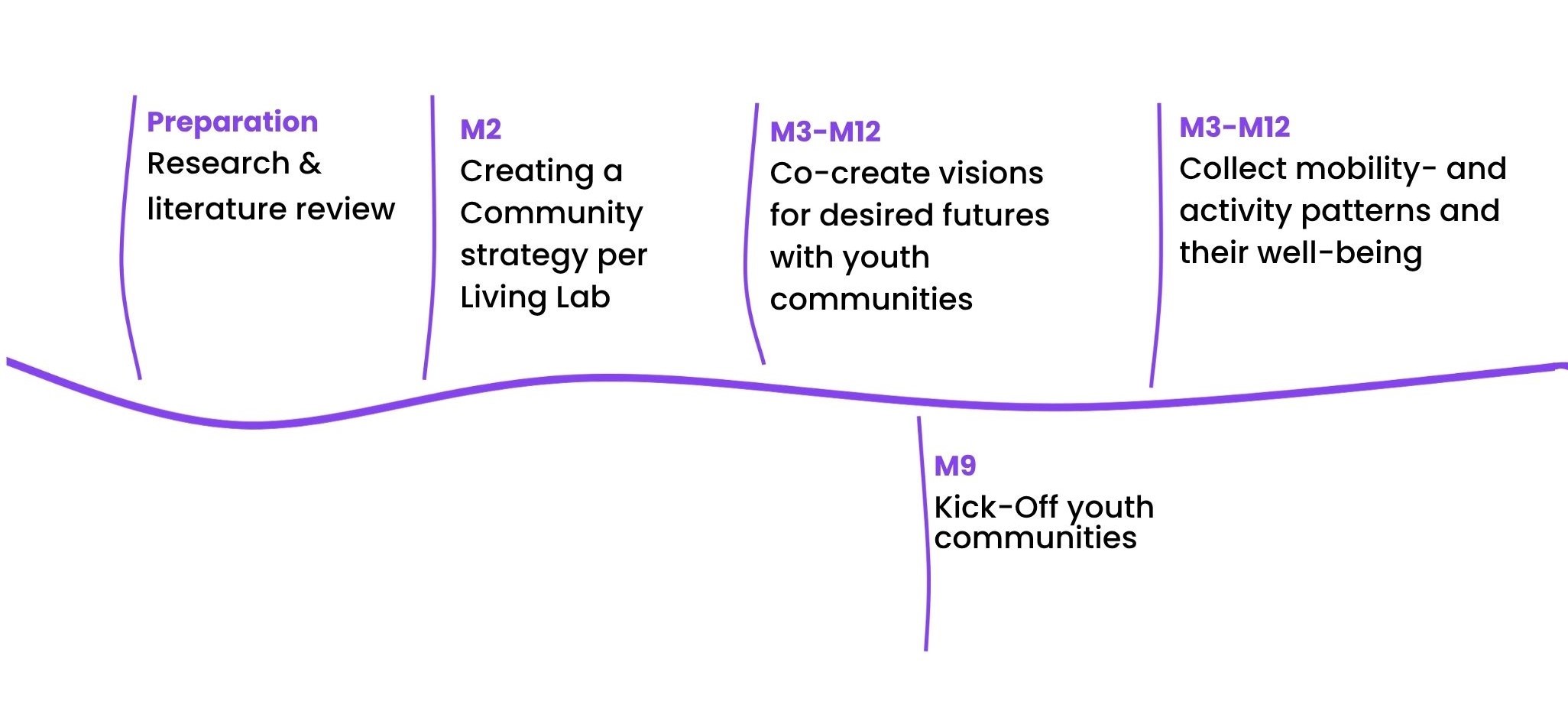
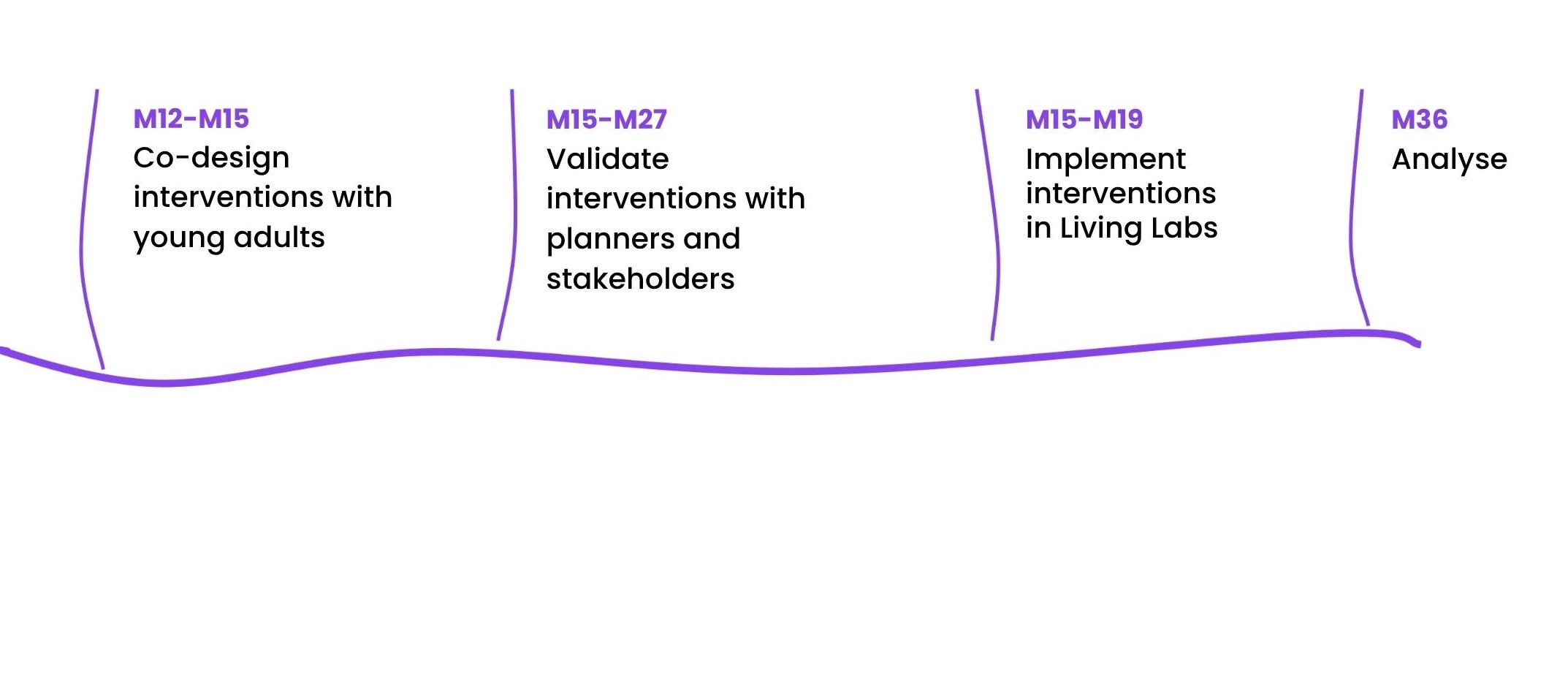
The timeline below shows how the seven work packages are sequenced across the project’s strategic planning cycle, from visioning to assessment. Full Projecttimeline: 02/2026 – 01/2029
The Expected Impact.
For Young Adolescents:
Active involvement in shaping their urban environment, greater awareness of the benefits of active mobility, empowerment.
For Cities & Policymakers:
Evidence-based, openly accessible tools and guidelines for youth-centric mobility planning.
For Science:
A new multinational evidence base, open-source software tools (e.g., a youth-specific version of the open-source tool NetAScore), and publications.
For Society:
Lasting change toward active, sustainable mobility — with positive effects on health, emissions, and social inclusion.